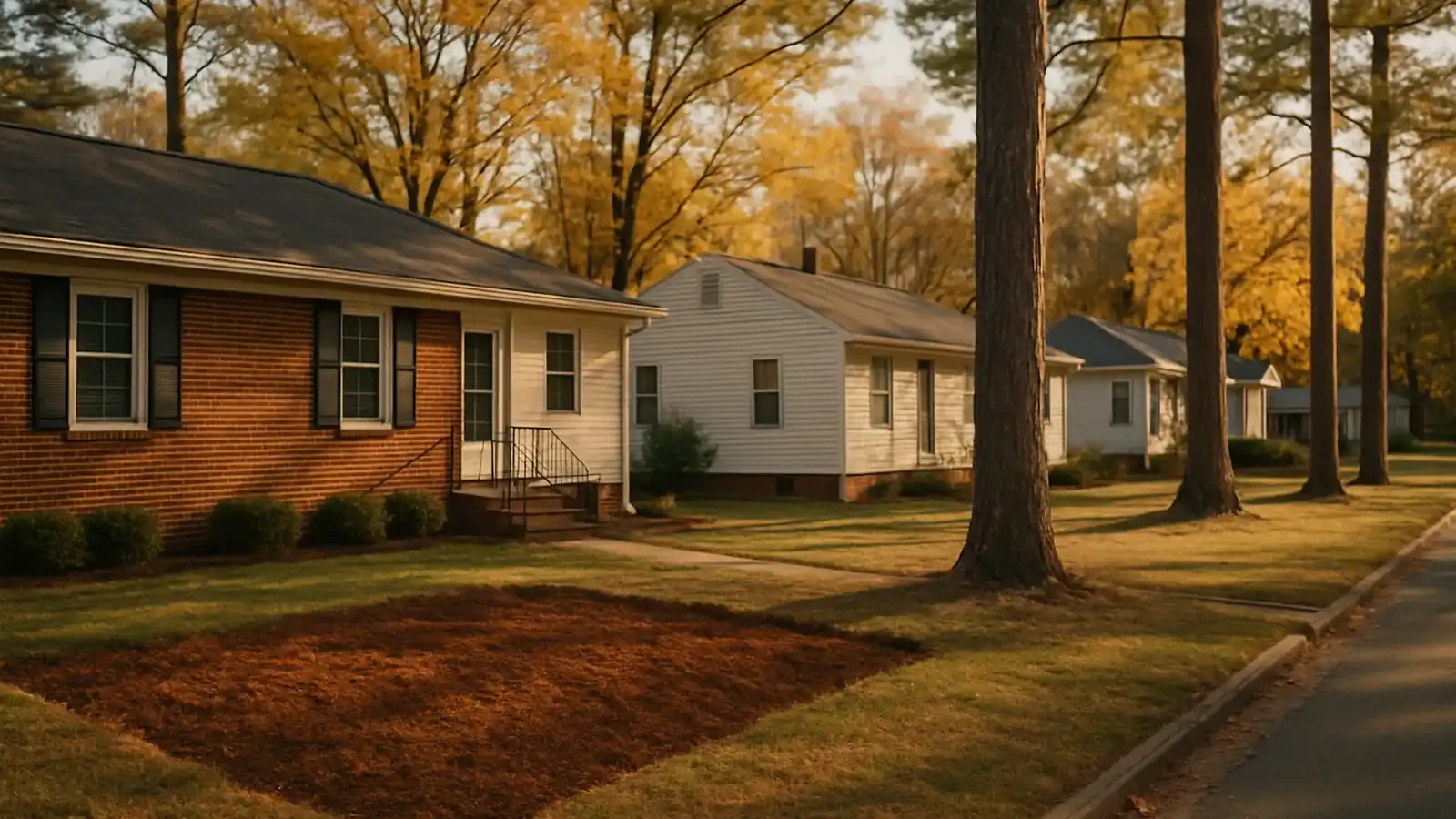
Gibsonville homeowners pay $500–$6,000 for most mold remediation, and around $300 for testing where it is warranted. Close-set lots dry slowly in shade and share drainage, so the inspection checks what is happening between the houses as well as under and above yours.
A small town built close together
Gibsonville grew as a railroad town and its older core reflects that: compact housing on modest lots, buildings close to one another, and a downtown of older structures. That density has a specific moisture consequence on Piedmont clay.
Water that can't soak into the ground has to go somewhere, and on tight lots the somewhere is between the houses: along side yards that are narrow, shaded, and slow to dry. Where the grade between two buildings has flattened over decades, water stands there and works on both foundations at once. It's an easy thing to overlook because nobody spends time in a three-foot side yard, and it's frequently the whole explanation for a damp crawl space.
Shade, airflow, and slow drying
Close-set buildings and mature trees mean exterior walls on the north and between-building sides stay damp longer after rain and get less air movement to dry them. That's the outdoor version of the cold-wall problem, and it contributes to both crawl space humidity and exterior wall staining. Clearing vegetation back from the building line and getting downspouts to discharge well clear of the side yard are among the cheapest corrections available here.
Older housing, familiar profile
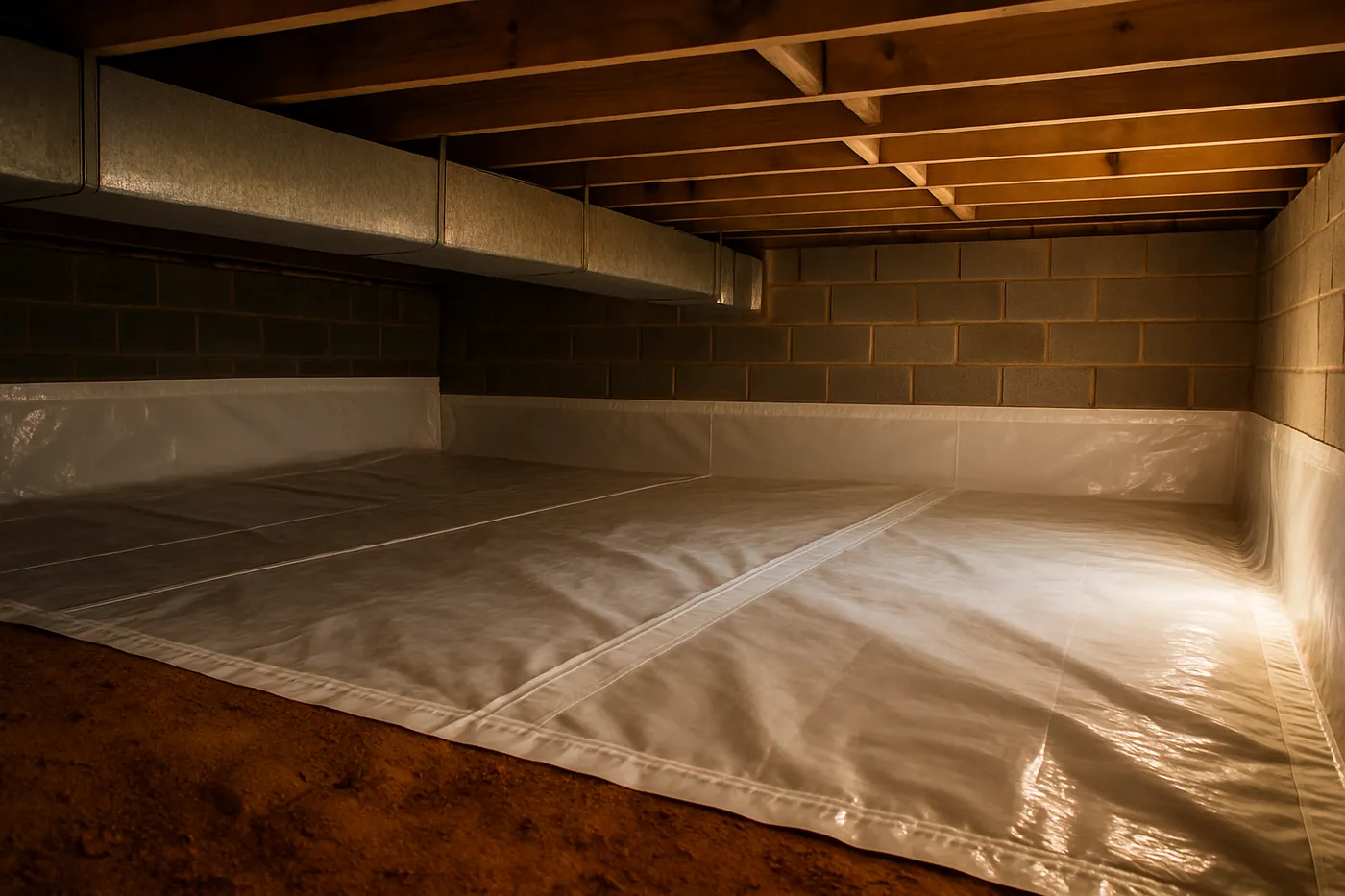
The housing itself follows the Triad's older pattern: crawl spaces without vapor barriers over bare clay, ceilings never air-sealed against winter moisture, bath fans terminating in the attic or nowhere, and duct insulation that has aged out. Those are specific and affordable to correct once someone measures, which is why the inspection is worth booking.
Two counties, one town
Gibsonville straddles the Guilford and Alamance county line, which occasionally matters for permitting on reconstruction work. Ask the specialist which jurisdiction covers your address and to name it in the scope, rather than leaving you to discover it at inspection.
Asked in Gibsonville
Water stands in our side yard. Is that causing the crawl space problem?
Frequently it's the whole explanation. On tight lots, water that can't soak into red clay runs between the houses into narrow side yards that are shaded and slow to dry. Where the grade there has flattened over decades, it stands and works on the foundation. Nobody spends time in a three-foot side yard, so it goes unnoticed.
Our north-facing walls stay damp. Related?
It's the same drying problem outdoors. Close-set buildings and mature trees keep those walls damp longer after rain with less air movement to dry them, which contributes to crawl space humidity and exterior wall staining. Clearing vegetation back from the building line is among the cheapest corrections available.
What does mold removal cost in Gibsonville?
The area ranges apply: $500 to $6,000 for most residential remediation, $2,000 to $6,000 for crawl space work, $1,500 to $5,000 for attic remediation. On older housing here many findings are inexpensive corrections (a vapor barrier, duct insulation, a bath fan termination) rather than remediation.
Gibsonville is in two counties. Does that affect the work?
Occasionally, on permitting for reconstruction. Ask the specialist which jurisdiction covers your address and to name it in the scope, rather than leaving you to discover it at inspection. The remediation itself is the same either way.
An old town that is now mostly new houses
Gibsonville's core is old, but its housing count has been reshaped by recent growth. Census estimates for 2020-2024 count about 4,000 housing units, and the median one was built in 2004; the 2010s alone account for about 36%, the largest share of any decade. Homes from before 1940 are about 5%. So the close-set older housing described above is now a minority of the town's homes, and a newer Gibsonville house deserves its own diagnosis rather than the old-town one.
Who inspects in Gibsonville
Gibsonville's planning page says building inspections and certificates of occupancy are handled by the Alamance County Inspections Department, which also serves Elon, Green Level and Haw River. The town runs its own stormwater program and warns that the most dramatic consequence of runoff is flash flooding that can reach streets, businesses and homes. USGS keeps a gauge on Reedy Fork near Gibsonville, the nearest public record of how local water rises.
Get a Greensboro mold inspection
Tell us what you’re seeing: a musty smell near the floor, dark streaks on attic sheathing, staining on a wall, water standing against the foundation, and we'll pass your request to one independent local specialist, who can set up an inspection. A local specialist who works in Greensboro will call you back.