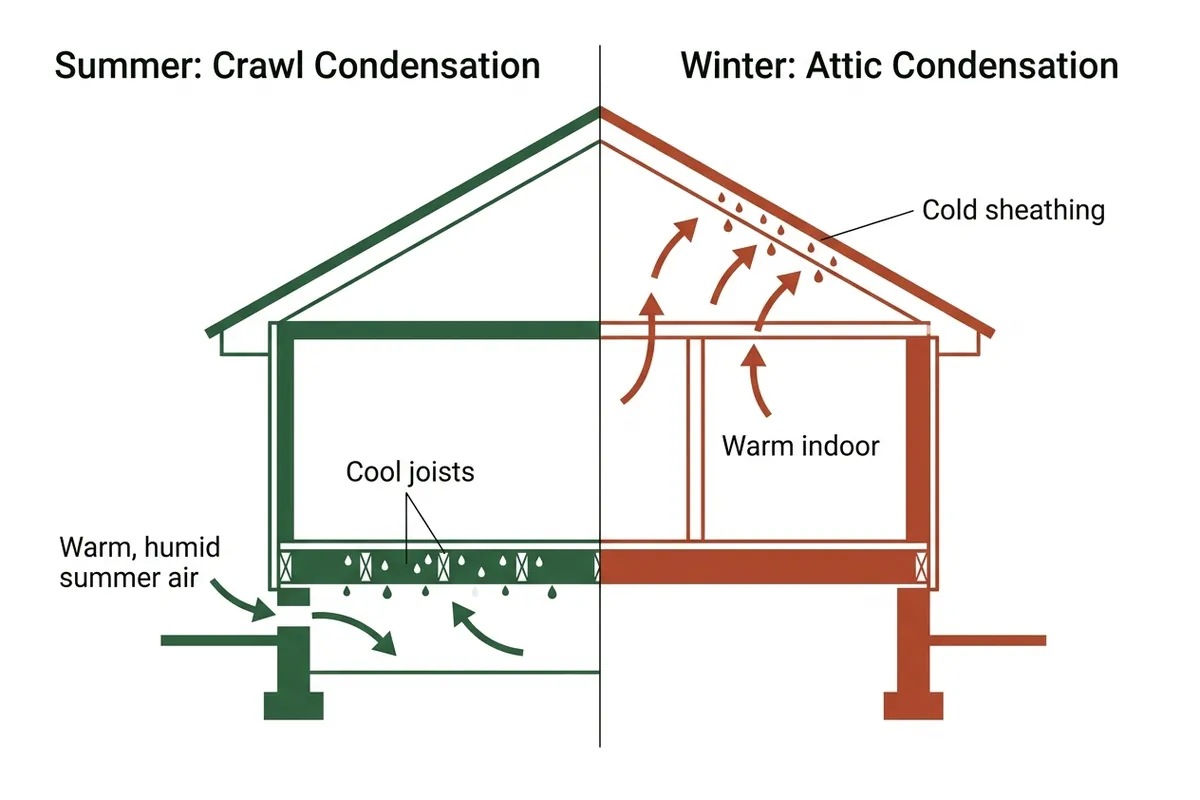
Mold remediation in Greensboro costs $500–$6,000 for most residential jobs in the living space, set by area affected and whether materials come out. The work is containment, physical removal, and HEPA filtration, plus correcting the moisture source — here usually the crawl space or the attic rather than the room.
Here's what proper remediation involves, and why cold walls produce their own version of this.
The standard, in the order it happens
- Find and stop the moisture. In the Piedmont that investigation usually ends up below the floor or above the ceiling rather than in the affected room.
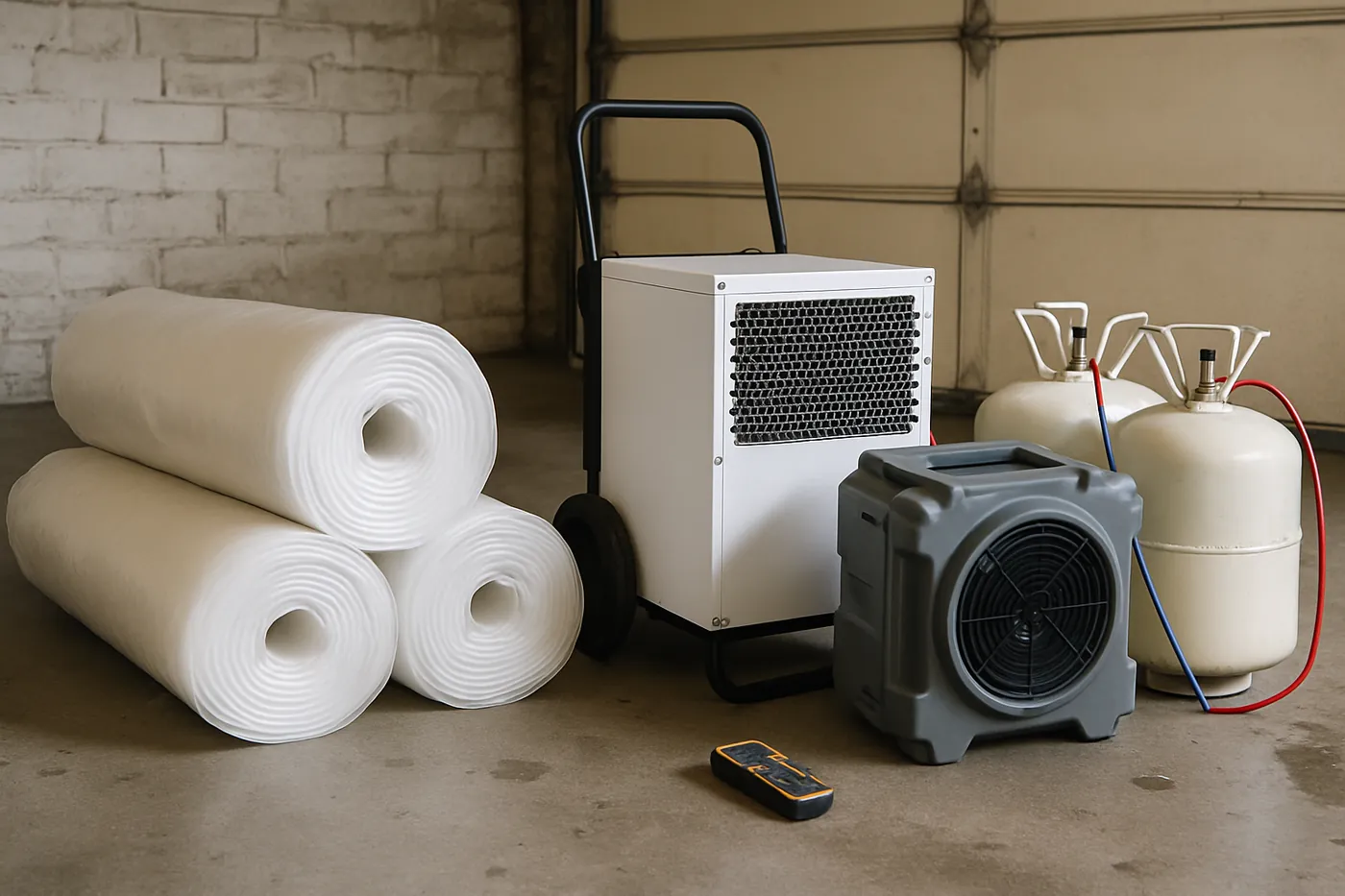
- Contain the area. Barriers plus negative air pressure, so removal doesn't distribute spores through the house.
- Remove what can't be cleaned. Porous material that grew mold comes out; non-porous surfaces get cleaned.
- HEPA-filter and clean. Air scrubbers through the work and after it, surfaces HEPA vacuumed and wiped.
- Dry to a measured target. Meters decide when materials are ready to close, not the calendar.
- Rebuild once the readings allow it.
Removal, not treatment
The distinction that separates real remediation from an expensive imitation. EPA guidance is direct: the job is physically removing the mold and the porous material it colonized. Because mold doesn't have to be alive to cause a problem, killing it and leaving it in place doesn't complete anything.
A company offering to fog the house, spray an antimicrobial, or run an ozone generator instead of removing affected material is selling something that won't resolve this. Those tools have narrow uses on already-cleaned surfaces. None replaces removal.
Cold walls: the living-space version of the winter problem
Homeowners are often puzzled to find growth on an exterior wall behind a dresser, or in a closet on an outside corner, and assume there's a hidden leak. Usually there isn't. Those surfaces stay colder than the rest of the room and get almost no air movement, so indoor moisture condenses on them in winter exactly the way it does on attic sheathing — just at a milder temperature difference.
The corrections are often trivially cheap: pull furniture a few inches off exterior walls so air can move behind it, leave closet doors open on outside walls, improve insulation where a wall reads notably cold, and keep winter indoor humidity around 30 to 40 percent. We'd rather hand you that list than schedule a remediation you didn't need.
What drives the price
- Area affected — measured, not estimated from a doorway
- Material removal and rebuild — frequently the largest line, and the usual reason a low bid grows
- Containment complexity — open plans need more barrier than closed rooms
- The moisture correction — priced visibly, because if the source is the crawl space or the attic, remediating the room alone buys you this twice
What does the material it grew on change?
Two houses with the same square footage of growth can need very different work, because what mould has grown into decides whether it can be cleaned or has to be removed. The Triad's early-twentieth-century mill housing raises this more often than newer stock.
| Material | Cleaned or removed | Why |
|---|---|---|
| Framing and sheathing | Cleaned in place | Dense wood holds growth at the surface where it can be removed |
| Drywall and paper facing | Removed | Paper is food; cleaning the face leaves the core colonised |
| Batt insulation | Removed | It cannot be cleaned and it holds the moisture that started it |
| Original plaster and lath | Assessed carefully, usually kept | Mineral plaster is not food; the lath behind it is what needs judging |
Spread is also what moves the bill: residential jobs here land between $500 and $6,000, and which end you get depends on the square footage far more than the species. Anyone quoting demolition of original plaster before looking behind it is pricing convenience rather than the actual problem.
Remediation questions, straight answers
What does mold remediation cost in Greensboro?
Most residential jobs in the living space run $500 to $6,000, set by area affected, whether materials must be removed and rebuilt, and how much containment the layout requires. A single bathroom wall is the low end; growth across several rooms with material removal is the high end. The inspection is free.
Do we need to move out?
Usually not. Containment with negative air pressure exists specifically so the rest of the house stays usable while one area is worked. Where the affected area is large, involves the only bathroom, or someone in the household has a respiratory condition, we'll say plainly that staying elsewhere is the better call.
Why is there mold on our exterior walls in winter?
Cold-surface condensation, the same physics as the attic. An exterior wall behind furniture or inside a closet stays colder than the room and gets less air movement, so indoor moisture condenses there. Pulling furniture a few inches off exterior walls and lowering winter indoor humidity resolves a surprising share of these.
Do you use fogging or antimicrobial spraying?
Not as a substitute for removal. EPA guidance is that remediation means physically removing the growth and the porous material it colonized. Mold doesn't need to be alive to cause a problem, so killing it in place doesn't finish the job. Any bid built on fogging instead of removal deserves hard scrutiny.
Will it come back?
Only if the moisture source stays. That's why the scope names the source explicitly — and in this market it's frequently the crawl space in summer or the attic in winter rather than the room where you found it. Remediating the room while leaving the mechanism running is how people pay twice.
Get a free Greensboro mold inspection
Tell us what you’re seeing — a musty smell near the floor, dark streaks on attic sheathing, staining on a wall, water standing against the foundation — and we’ll schedule an inspection that goes into the crawl space and the attic. We reply the same business day.